Research
Quantum transport in topological and superconducting devices
Topological quantum devices
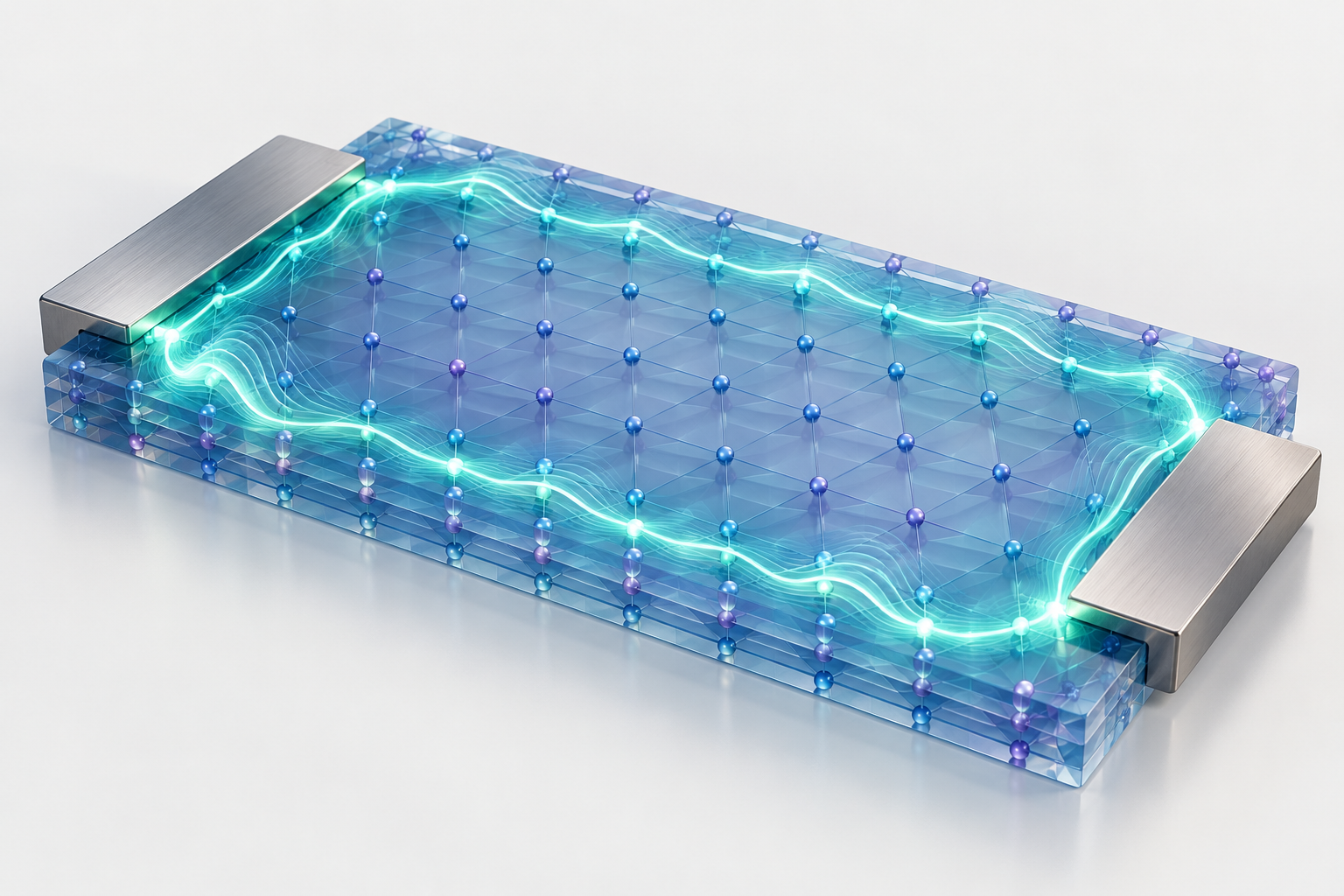
Seek new topological quantum materials, explore and understand novel mechanisms and phenomena in these materials, and use them to build functional devices.
MnBi₄Te₇: disorder-induced topological state
Observe a quantized Hall plateau accompanied by vanishing longitudinal resistance in monolayer MnBi₄Te₇, and identify the role of disorder in driving the transition from a clean-limit trivial insulator to a topological Anderson Chern insulator [6]. Use complementary theoretical analysis to map the disorder-driven phases and identify a finite disorder window supporting the Chern state, as well as the possible coexistence of topologically nontrivial and trivial insulating states [7]. These results reveal how disorder and magnetism can create and reshape topological transport.
Topological–superconductor hybrid devices

Construct hybrid quantum devices from topological and superconducting materials to search for signatures of unconventional superconductivity and investigate fundamental Andreev and Josephson physics.
Ta₂Pd₃Te₅–Al: an interfering Josephson diode
Construct Ta₂Pd₃Te₅–Al junctions with proximity-induced edge supercurrents whose interference produces nonreciprocal critical currents. Achieve a Josephson diode efficiency of up to 73% at small applied magnetic fields, with picowatt-scale switching power, using an asymmetric edge interferometer [5]. Identify unequal edge supercurrents, magnetic flux and higher harmonics in the current–phase relation as the key ingredients of the diode behavior, and confirm the second harmonic through half-integer Shapiro steps [5]. This work connects fundamental Josephson physics with low-power superconducting rectification.
Cr-doped (Bi,Sb)₂Te₃–superconductor hybrids
Ongoing research
Explore hybrid quantum devices combining the magnetic topological insulator Cr-doped (Bi,Sb)₂Te₃ with superconductors. Investigate novel Andreev and Josephson transport arising from the interplay of magnetic order, topological electronic states and superconducting proximity effects, aiming to identify unconventional superconducting signatures and probe possible Majorana physics.
Intrinsic unconventional superconducting devices

Use phase-sensitive experiments and complementary techniques to determine the pairing symmetry of candidate unconventional superconductors.
K₂Cr₃As₃: protective fabrication and phase-sensitive experiments
Develop a protective fabrication procedure compatible with electron-beam lithography for quantum devices based on air-sensitive K₂Cr₃As₃. Demonstrate Josephson interference, a diode effect and half-integer Shapiro steps in K₂Cr₃As₃–Al SQUIDs, establishing a platform for phase-sensitive studies [8]. Analyze critical-current interference and microwave-induced Shapiro steps to reveal a substantial second harmonic and a crossover toward a π-dominated phase state, providing evidence in favor of p-wave pairing [9].
Nickel-based superconductors: order-parameter symmetry
Ongoing research
Use tunneling spectroscopy, Andreev-reflection spectroscopy and phase-sensitive experiments to determine the symmetry of the superconducting order parameter in nickel-based superconductors.
Little–Parks-like measurements of the superconducting order parameter
Ongoing research
Use Little–Parks-like measurements in ring devices made from candidate unconventional superconductors to determine the superconducting order parameter. Aim to resolve flux-dependent oscillations and their phase structure, and combine these observations with complementary phase-sensitive measurements to test candidate pairing symmetries.